

The short version: Eight hours at the wrong time is not the same as eight hours at the right time. After 50, when the circadian window for deep sleep has shifted earlier and become narrower, the timing of your sleep window matters as much as its length. Going to bed an hour or two later than your biology prefers costs more than that hour back in sleep quality – it costs you the deep-sleep phases that front-load the early night.
December 2025. I tracked eight and a half hours of sleep, fifth night in a row. The same calendar hours I had been documenting through much of the year. Woke up feeling like I had barely slept. Foggy all day. No logical explanation until I looked at the data more carefully.
The hours were 1am to 9:30am. Every single night. Late evenings, late mornings, the week had drifted. And despite being longer than my usual window, the sleep quality scores were consistently lower than when I slept 10pm to 6am for the same number of hours.
That was the night Professor Debra Skene’s circadian research became genuinely useful to me rather than just intellectually interesting.
Why Timing Is Not Just About Preference
Every cell in the body keeps time. Russell Foster at Oxford – one of the leading circadian neuroscientists – has documented this clearly: the suprachiasmatic nucleus (SCN) acts as the master pacemaker, coordinating timing across all organs including the liver, gut, and immune system. The body does not have one clock. It has a network of clocks, all coordinated by the SCN, which is itself set by light.
Till Roenneberg, whose population-scale work on chronobiology at the Ludwig Maximilian University remains the most comprehensive of its kind, has shown that 15 to 40 percent of all genes in the human body switch on and off at different times of day. Timing affects virtually every metabolic and physiological process. Eating, sleeping, exercising, even taking medication – when you do these things relative to your circadian clock matters as much as what you do.
For sleep specifically, this plays out in how the deep-sleep phases are distributed through the night. The first slow-wave deep sleep episode of the night is the deepest and the most restorative. It happens in the first 90 to 120 minutes of sleep, and it requires the body’s circadian timing to be aligned with actual darkness and temperature drop. Shift the sleep window later – even by two hours – and you are entering the first deep-sleep phase at a point in the circadian cycle when the system is already starting to transition out of the sleep-promoting mode.
The result: the first deep-sleep cycle is shallower and shorter. Growth hormone release, which peaks during that first cycle, is reduced. The glymphatic cleaning process, which requires deep slow-wave sleep to operate at full capacity, gets less time. The second half of the night – which is already lighter sleep – is now doing more of the total work, with less recovery already banked.
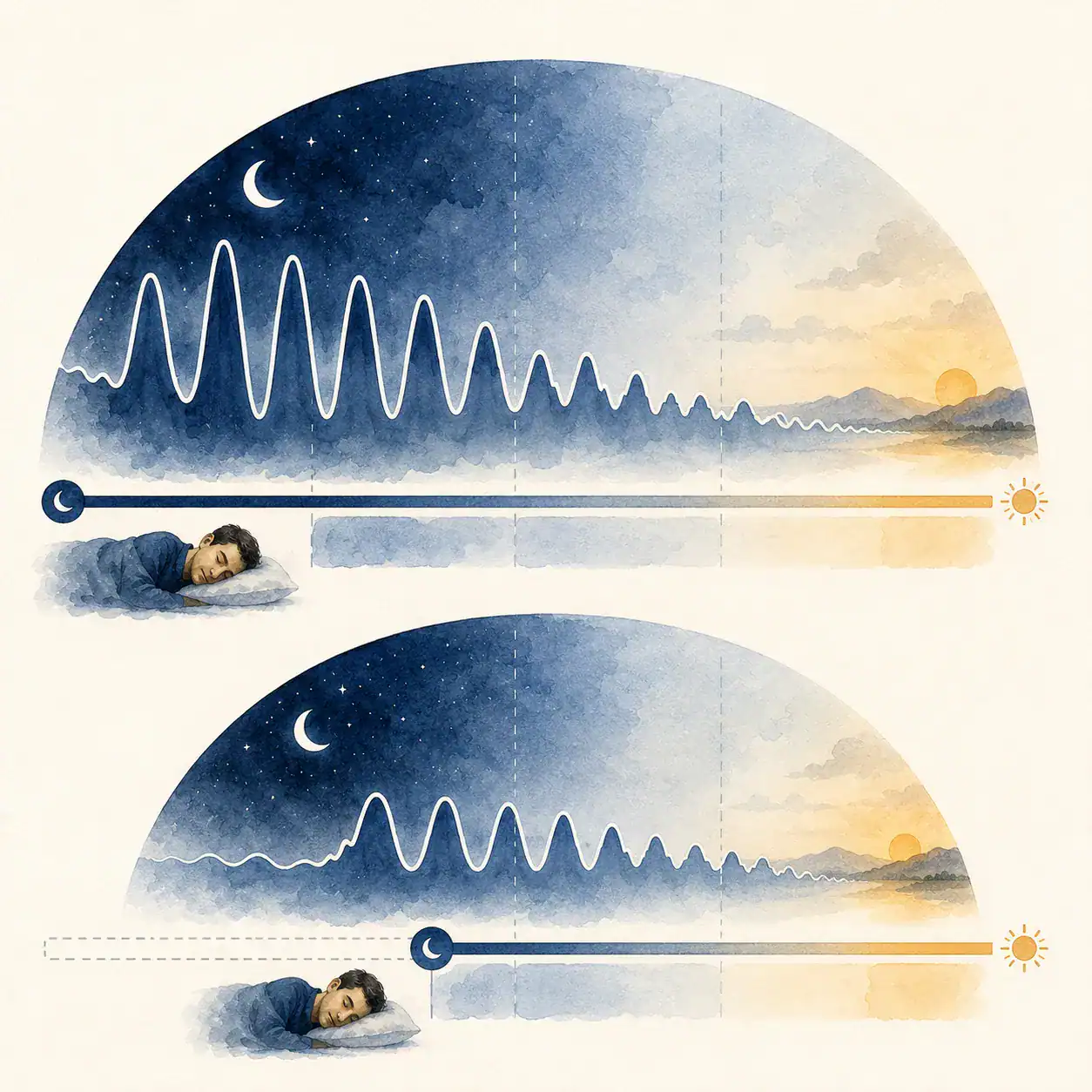
The Earlier Shift After 50
After 50, the circadian window typically shifts earlier. This is well-documented in chronobiology: the chronotype – the biological preference for when to sleep and wake – moves toward earlier timing as people age, becoming what researchers sometimes call the Lion pattern rather than the Bear or Wolf of younger adulthood.
Michael Breus’s work on chronotype is useful here: from age 65 onwards, the shift toward earlier sleep preference is clear, but the transition begins earlier – in the mid-forties for many people. The body starts wanting to sleep by 10 or 10:30pm in a way it did not at thirty-five. When you resist that pull – scrolling, watching television, staying up to match younger household members or social habits – you are working against a biological preference that has genuine downstream consequences for sleep quality.
Patrick McKeown summarises the relevant evidence directly: falling asleep between 10pm and 11pm appears to be the sweet spot for both sleep quality and heart health. Going to bed later starves you of deep sleep. This is not a prescription for everyone – chronotype varies, and the window that works for one person will not work for another – but the direction of the evidence for adults over 50 is clear: the body prefers earlier, and resisting that preference costs you in sleep architecture.
The Wake Time Matters More Than the Bedtime
Here is the counterintuitive piece that changed how I thought about this. Nick Littlehales, who has worked with professional sports teams on sleep optimisation, makes a specific claim that I have found consistently borne out in my data: a consistent fixed wake time is the single most powerful tool for improving sleep quality. Not the bedtime – the wake time.
The logic is circadian. The wake time anchors the body clock. Adenosine – the sleep pressure that builds up the longer you are awake – starts accumulating from the moment you rise. By fixing the wake time, you fix when sleep pressure peaks. Everything else in the sleep timing system adjusts downstream of that anchor. The bedtime becomes more naturally consistent because the appetite for sleep arrives more predictably.
The practical implication: if you want to shift your sleep window earlier, start with the alarm. Move the wake time earlier by 15 minutes every few days. The bedtime will follow without requiring willpower, because the sleep pressure will be higher earlier in the evening. This is slower than just forcing an earlier bedtime, but it works with the circadian system rather than against it.
What I Changed
Wake time: 6am, consistent. I do not always succeed. Travel disrupts it, late evenings happen. But when the anchor holds, the sleep quality data reflects it clearly. On weeks where the wake time is consistent, the sleep quality averages noticeably higher than weeks where it varies by more than an hour.
Bedtime: targeting 10pm. Not always achieved. But when it is, the deep-sleep tracking shows more first-half slow-wave sleep, better quality scores overall, and more reliable energy the following day.
The December 2025 drift – eight and a half hours starting at 1am, five nights running – was a natural experiment I did not intend. The data from it was unambiguous. The timing mattered more than the hours.
Educational content only. Not medical advice. Speak to your GP if you are experiencing significant sleep disruption or fatigue.
Day three of the 7-Day Sleep Reset covers the wake anchor – how to set your body clock by fixing one end of the sleep window before touching the other.
If you moved your wake time 15 minutes earlier tomorrow – just to test whether the evening followed – would you notice the difference by the end of the week?
More in sleep-science
- What 57 Nights of Perfect Sleep Actually Did to My Biomarkers
- The Sleep Myth That Keeps Over-50s Exhausted: Why “Catching Up” at the Weekend Does Not Work
- The Bedroom Habits That Ruined My Sleep for Years (And the Four That Fixed It)
- “I Sleep 8 Hours But Still Feel Exhausted”: Why the Hours Are Not the Problem
