

The short version: Sleep quality and sleep quantity are not the same thing. Eight hours of fragmented, poorly timed, or architecturally poor sleep is not equivalent to seven hours of the right sleep. The difference shows up the next day – in the afternoon energy, the mental sharpness, the hunger signals, the mood – in ways that tell you more about what happened at night than the number on the sleep tracker.
December 2025. Eight and a half hours on the tracker. Fifth night in a row of the same. Should have been the best-rested I had felt all week. Woke up foggy, unrested, the kind of tired that coffee does not quite reach. Something was obviously wrong.
The sleep window was 1am to 9:30am. That was the something.
Not too few hours. Wrong hours. The architecture of the sleep – where the deep slow-wave phases fell, when the circadian system was ready for them, whether the cortisol-melatonin handover had happened cleanly enough – was off. The tracker said eight and a half hours. The body said it had not slept.
What Eight Hours Actually Contains
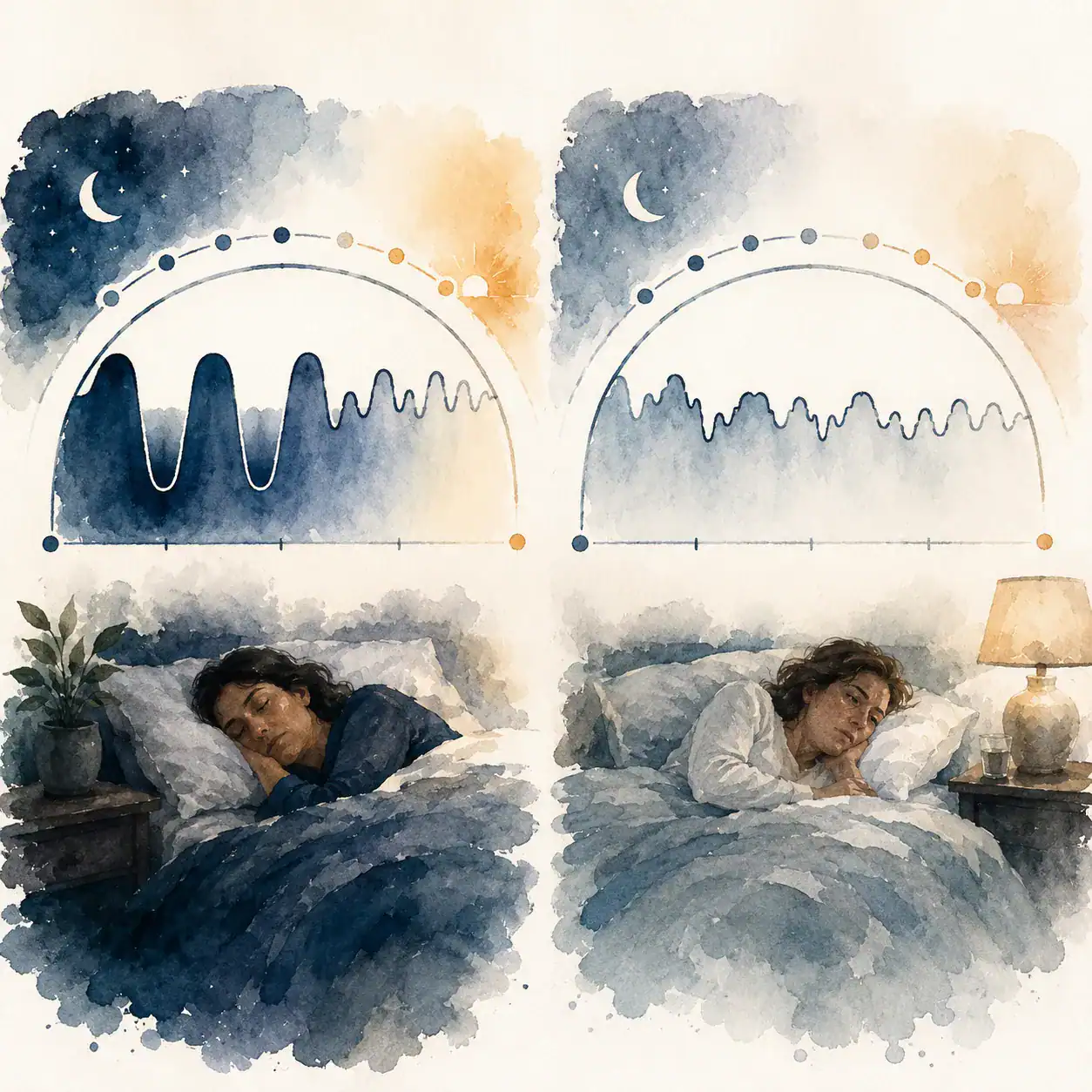
The brain runs in 90-minute sleep cycles. A normal eight-hour night contains roughly five complete cycles, each with its own architecture: light NREM sleep, deep slow-wave NREM sleep, REM. The distribution is not even. Deep slow-wave sleep – the most physically restorative phase – is concentrated in the first two or three cycles. REM sleep, critical for memory consolidation and emotional processing, is concentrated in the last two or three.
If those eight hours start at 1am instead of 10pm, you are entering the first deep-sleep phases at a point in the circadian cycle when the system is already starting to shift out of deep-sleep mode. The first cycles are shallower. Growth hormone release is reduced. The glymphatic system – the brain’s amyloid clearance mechanism – has less time to operate at full capacity. And the REM-heavy second half of the night now extends well into the morning, past the point when the circadian system is pushing wakefulness.
The result: eight and a half hours that feel like five. Not because the hours were not there. Because the architecture inside them was wrong.
Sleep Quality vs Sleep Quantity: The Research
Michael Breus, one of the most clinically reliable researchers in sleep medicine, is explicit: sleep quality matters more than sleep quantity. Poor sleep architecture causes unremembered awakenings that silently impair cognitive performance and metabolic health the next day. You can have no memory of waking and still have experienced fragmented sleep that failed to deliver the restorative phases properly.
Dr Jade Wu’s research on insomnia makes a related point: objective sleep measurements – total duration, efficiency, time awake – do not reliably predict daytime fatigue in people with poor sleep quality. A 2019 study of 598 insomnia patients found none of the measured sleep parameters correlated with fatigue the next day. The relationship is more complex than the tracker can capture.
Tim Spector at King’s College London, whose ZOE research programme is one of the most comprehensive on sleep and health, puts sleep regularity above sleep duration as a predictor of mortality risk. Going to bed at a consistent time – not simply sleeping long enough – is the more powerful variable. The body clock trains to a consistent schedule, and shifting bedtime by even an hour disrupts the natural cycle in ways that compound across weeks.
A separate Michael Breus finding worth knowing: sleep regularity – consistent sleep-wake timing – is associated with a 20 to 48 percent lower risk of death from all causes in the study population, independent of sleep duration. Not just better mood. Mortality. The consistency is doing work that the hours alone cannot.
What 295 Nights of Data Showed
You may have seen the WMTWL video – eight hours, still exhausted, what 295 nights of sleep data actually showed. The data story is all there, and I do not want to repeat it wholesale here. What I can add from the written record is the pattern I noticed when I extracted the quality scores against the timing data.
Quality correlated with timing more reliably than with duration. Nights where the window started consistently between 10pm and midnight – and the wake time was anchored at 6am – averaged notably higher quality scores than nights of equal or greater duration that started after midnight. The December 2025 period was the clearest example: eight and a half hours from 1am, five nights running, quality scores noticeably lower than weeks where seven hours from 10pm was the pattern.
The tracker counted the hours. The body marked the architecture.
What to Track Instead of Hours
If the hours are not the signal, what is?
Morning alertness without an alarm is one of the most honest signals of whether the night’s architecture delivered. Not needing coffee within the first 30 minutes is another. Stable afternoon energy without a significant dip. Hunger signals that arrive at normal meal times rather than immediately on waking or in an insistent way at 10am.
Sleep efficiency – the percentage of time in bed actually spent asleep – is a more useful metric than total hours. Dr Jade Wu defines healthy range as 85 to 95 percent. Consistently below 85 percent across two weeks indicates a problem worth addressing. Consistently at 100 percent may indicate you are not spending enough time in bed for the cycles to complete properly.
And the quality score on a simple 1 to 10 scale, rated on waking, correlates better with actual biological recovery than hours-based metrics. It captures the subjective reality that the tracker cannot see: whether you feel rested or whether you feel like you have been counted as sleeping while actually not being restored.
Also: the video that started this question – 8 Hours. Still Exhausted. – What 295 Nights of Sleep Data Actually Showed
Educational content only. Not medical advice. If you are experiencing persistent fatigue or sleep disruption, speak to your GP.
The 7-Day Sleep Reset focuses on the conditions for sleep quality – architecture, timing, and environment – rather than just the hours in bed.
Get the 7-Day Sleep ResetIf you tracked sleep quality on a 1 to 10 scale for a week alongside the hours – just to see whether the two matched – what do you think you would find?
Does sleeping a full 8 hours guarantee good rest?
Not necessarily. Evidence suggests sleep architecture and timing matter as much as total hours. Eight hours starting late in the night can deliver shallower deep-sleep phases than seven hours on a consistent, earlier schedule.
What should I track instead of total sleep hours?
Sleep efficiency (time asleep vs time in bed), morning alertness without an alarm, and a simple 1-10 quality score on waking tend to reflect restorative sleep more reliably than the hours figure alone.
- Michael Breus – research on sleep quality vs sleep quantity and unremembered awakenings
- Dr Jade Wu – insomnia and sleep efficiency research, including a 2019 study of 598 insomnia patients
- Tim Spector, King’s College London (ZOE) – sleep regularity as a predictor of mortality risk
- Michael Breus – sleep regularity and all-cause mortality risk findings
