
MECHANISM ENGINE
What Is Circadian Rhythm?

Sleep’s the layer I don’t have blood test data going back to 2012 on. What I do have is thirteen years of noticing that nothing else works properly when this one’s off. Fasting gets nearly impossible on four hours’ sleep. That’s not a coincidence.
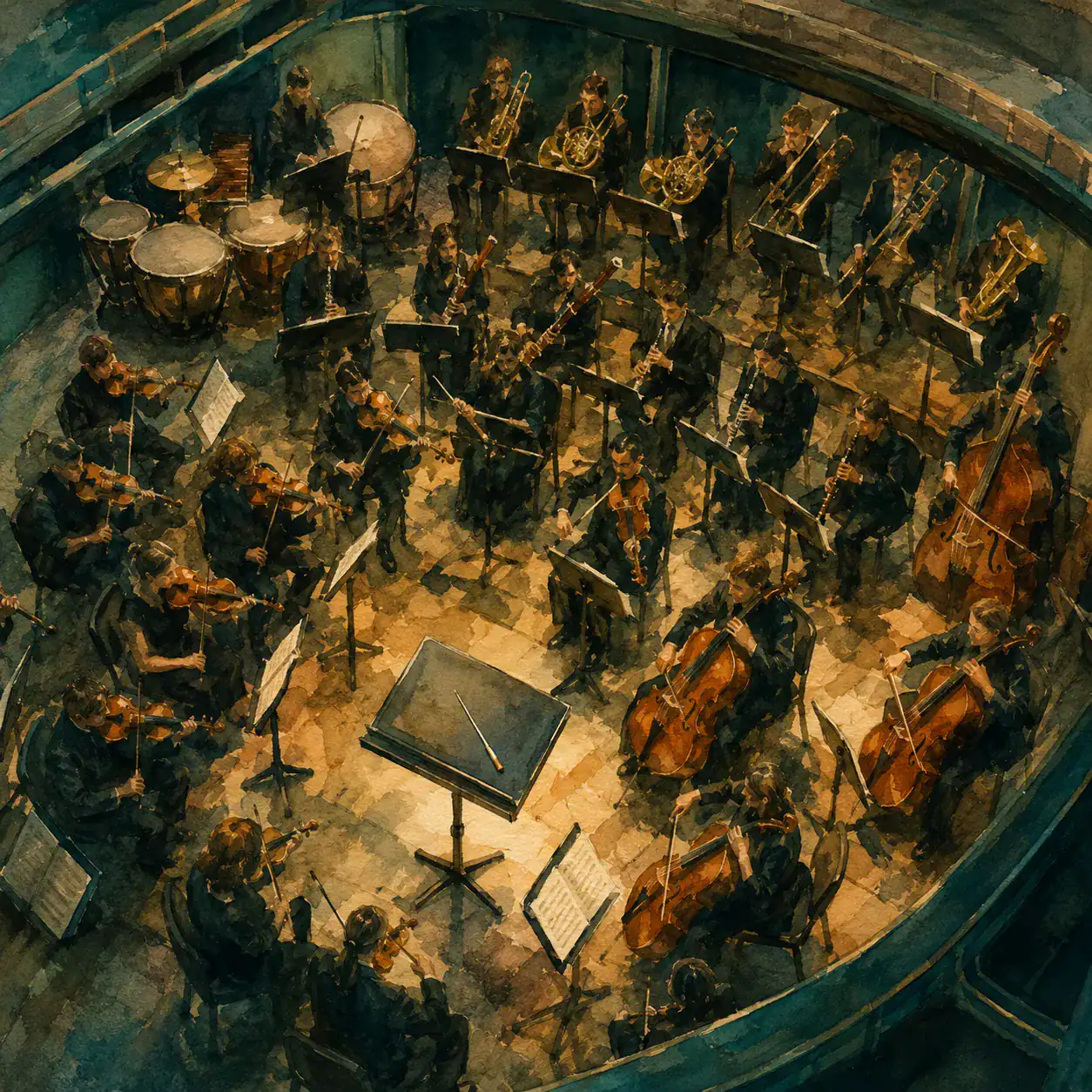
The Conductor at the Proms
Your circadian rhythm is the conductor, and every organ in your body is a section of the orchestra, all with their own smaller internal clocks. Liver, gut, muscles, all keeping their own time. Without a conductor, every section might technically still be able to play, but not together, not in time with each other. Bright light, meal timing, and sleep timing are what the conductor uses to keep everyone playing the same piece at the same tempo. Shift work, late-night light, and irregular meal timing all confuse the conductor, and the whole orchestra starts to drift out of sync with itself.
Circadian rhythm is the roughly 24-hour internal clock, governed mainly by light exposure, that regulates sleep, hormone release, body temperature, and digestion. A master clock in the brain synchronises smaller clocks in individual organs. Misalignment, from irregular sleep timing, shift work, or late eating, is linked to poorer glucose control, disrupted hunger hormones, and reduced sleep quality, even when total sleep hours look adequate on paper.
NHS sleep guidance and NICE materials on shift work both identify circadian disruption as a contributor to metabolic and cardiovascular risk, distinct from sleep duration alone.
Articles referencing this concept will populate here automatically as the Library builds.
Related mechanisms
Educational only, not medical advice. Speak to your GP before changing your fasting pattern, diet, or medication.
What this is based on
NHS and NICE guidance, cross-referenced against Neil’s own NHS blood test record going back to April 2012. See the full timeline and current numbers.