

The short version: Cortisol should fall through the evening and reach its lowest point around midnight to allow melatonin to rise and deep sleep to begin. When cortisol stays elevated – through eating late, screen light, poor morning routine, or the structural rise that comes with age – the brain stays on alert at the wrong hour. The ceiling stare is biology, not weakness of mind.
In October 2025, I tracked something I had been suspecting for a while. Four hours of sleep. The body started raiding the snack cupboard for quick fuel by mid-morning. Not because I was undisciplined. Because sleep deprivation spikes ghrelin – the hunger hormone – and suppresses leptin, the signal that says enough. One bad night altered the next day in ways I could measure.
And the bad night, when I looked back at it, had followed a late eating window, screens running to 10pm, and a work deadline I had been turning over in my head when I should have been winding down. The cortisol had never really fallen.
This is the connection most sleep advice skips over: the problem often starts in the afternoon, not the bedroom.
What Cortisol Is Supposed to Do
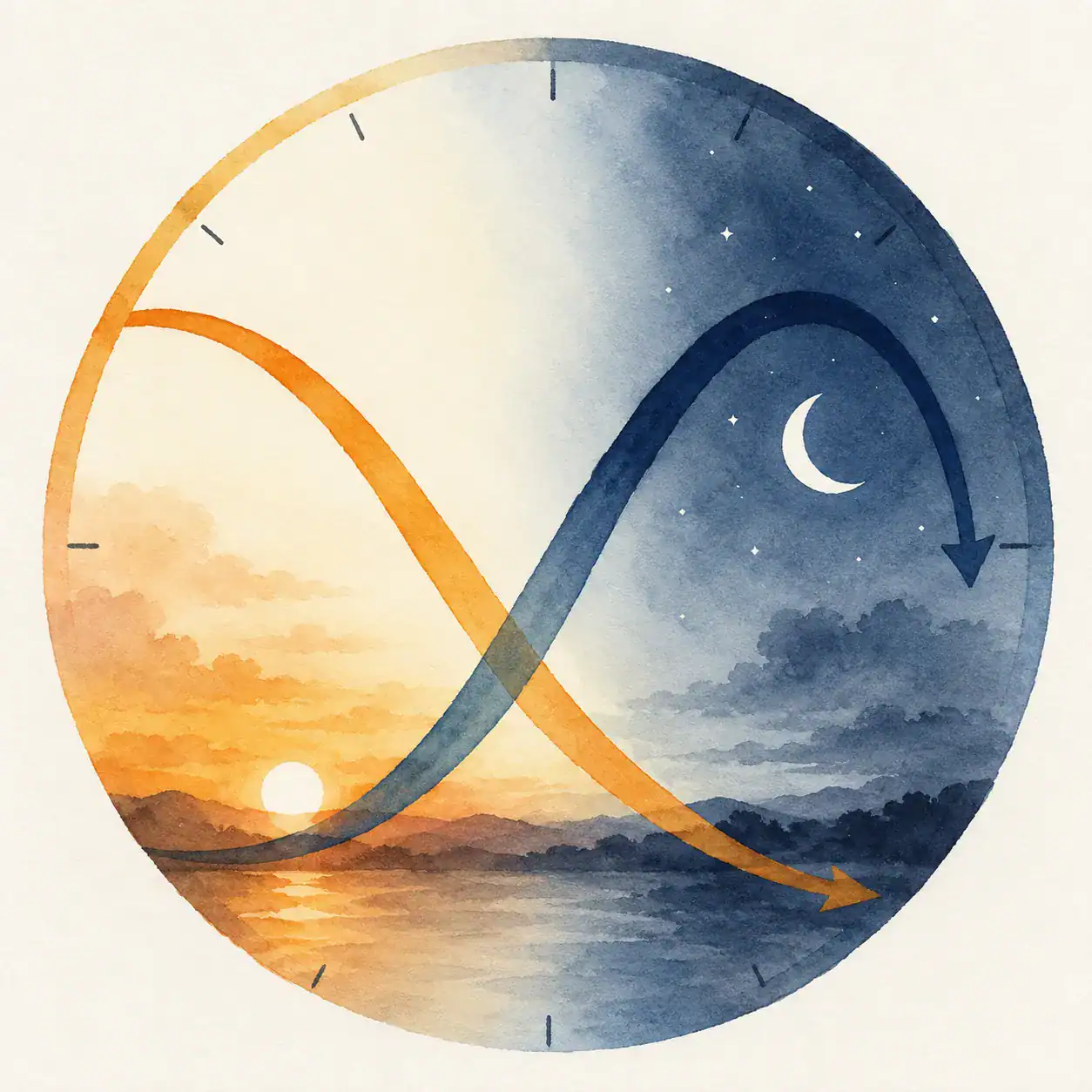
Cortisol follows a daily pattern that is quite precise. Izabella Wentz’s research describes it clearly: cortisol should be highest in the morning – roughly 20 to 30 minutes after waking, what researchers call the cortisol awakening response – to drive alertness and energy for the day. From there it falls steadily through the afternoon and evening, reaching its lowest point around midnight. As cortisol drops, melatonin rises. The handover is the gateway to deep sleep.
When that handover does not happen cleanly – when cortisol is still elevated at 10pm, 11pm, midnight – melatonin cannot reach the level it needs. The body stays in a low-level alert state. You feel tired but wired. You can get to sleep eventually, but the deep, slow-wave stages that come in the first third of the night are compressed or interrupted. And the second half of the night – already more fragile after 50 – becomes broken.
Hans Selye, the endocrinologist who spent his career on stress physiology, put this with characteristic directness: insomnia has a chemical basis. Adrenaline and cortisol produced during the day are still circulating at night. What you do during the day determines how you sleep that night. By bedtime, it is already too late.
That last line is worth sitting with. By the time you are trying to sleep, the evening’s cortisol chemistry is already set. The intervention – if there is one – happens hours earlier.
The Modern Inputs That Keep Cortisol Up
A handful of modern habits are particularly effective at preventing the cortisol handover from happening:
Late eating. Eating within two to three hours of sleep keeps the digestive system active and insulin elevated at a time when both should be winding down. The metabolic system reads food as a wakefulness signal. Federica Amati’s research at ZOE confirms this directly: eating close to bedtime suppresses melatonin production and reduces time in deep and REM sleep. The body cannot manage both active digestion and deep sleep simultaneously. One wins, and it is not sleep.
Screen light in the evening. Blue light from screens tells the hypothalamus that it is still daytime. The suprachiasmatic nucleus – the master circadian clock – uses light as its primary input for knowing what time it is. Matthew Walker’s research shows that two hours of LED screen use delays the melatonin rise by up to three hours. This is not a trivial delay. It is the equivalent of a transatlantic time zone shift, taken every night.
Unresolved stress loops. Hard work that comes to a clean stop helps you sleep. Hard work that sets up self-maintaining tension keeps you awake. This observation, from Hans Selye’s clinical writing, identifies a mechanism that explains a lot of the “I don’t feel stressed, I just can’t switch off” experience. The prefrontal cortex – the part of the brain responsible for emotional regulation and executive function – is the area most sensitive to cortisol load. When it is running hot, it is hard to close the loop on the day and let the system down.
The structural cortisol rise with age. This is the one you cannot undo with habits alone, but it is useful to know about. Sara Gottfried’s research notes that cortisol levels rise structurally by approximately 20 percent between the ages of 50 and 89, independent of stress. The floor from which cortisol needs to fall each evening is already higher than it was at thirty. This means the same evening habits that produced fine sleep at 35 may not produce fine sleep at 52. Not because you are doing them wrong. Because the baseline has shifted and the habits need to compensate for it.
What This Looked Like in My Data
The sleep-cortisol connection became very concrete for me during the 70-Day Rhythm Reset I ran in late 2025. On days where sleep dropped below five hours, the next day was measurably harder on every front: energy lower, cravings stronger, decision-making more reactive. The ghrelin and leptin shift is not subtle when you are tracking it. Ghrelin up, hunger constant, reaching for things I would not normally reach for.
What that taught me practically: by the time the cravings were happening, I had already lost the intervention window. The cortisol had spiked the previous night. The hunger was downstream of that. The only lever was what I did the evening before – eating window, light, and whether I had actually closed the loop on the day’s work before trying to sleep.
Not willpower. Not discipline at the biscuit tin. The inputs that determined the next day’s cravings were set the night before, and the night before’s sleep quality was set the afternoon before that.
Hans Selye’s line keeps proving itself in my data: by bedtime, it is already too late.
The Accelerator and the Brake
Your nervous system has two modes. Sympathetic – foot on the accelerator. Heart rate elevated, digestion slowed, muscles ready, cortisol circulating, alert for threats real or imagined. Parasympathetic – foot on the brake. Heart rate drops, breathing slows, digestion activates, cortisol falls, repair mode begins.
Sleep requires the brake. And if you have been running on the accelerator – through work pressure, late meals, screen light, the low-level background hum of a busy life – the nervous system does not have an automatic off switch. The freight train of cortisol and adrenaline, as Robert Sapolsky memorably framed it, takes time to slow once it is moving. The argument is over. The deadline has passed. But the train is still running at speed.
Breathwork, a cooled-down evening, an earlier eating window, a morning walk to anchor the cortisol awakening response – these are not sleep hacks. They are the conditions that allow the brake to work properly. They remove the foot from the accelerator gradually enough that by 10pm, the system can actually use the brake it has.
What Helped
The specific changes that moved my cortisol pattern were, in rough order of impact:
Closing the eating window earlier. This was the single biggest shift. Once the last meal was finishing by early evening, my cortisol had time to fall before I needed it to. The metabolic system was not competing with active digestion in the window between 9pm and midnight.
Morning light within an hour of waking. Andrew Huberman’s work on the cortisol awakening response is precise: anchoring the morning cortisol peak with light exposure sets the timing for the whole day’s arc. If the peak fires clearly in the morning, the floor at night is lower. The timing of the daily cortisol pulse matters as much as its height.
Screen curfew before 8pm. This protected the melatonin rise that cortisol needed to hand over to. Without it, melatonin could not reliably rise, and cortisol had nowhere clean to fall.
None of these targeted sleep. They targeted cortisol’s conditions. The sleep improved because the chemistry improved. That distinction matters, because it changes where you look for the problem.
Educational content only. Not medical advice. Speak to your GP if you are experiencing significant sleep disruption, unexplained fatigue, or any symptoms that concern you.
The 7-Day Sleep Reset includes a step specifically on the evening cortisol taper – what to do differently in the hours before bed so the chemistry is ready when you are.
Get the 7-Day Sleep ResetIf the ceiling stare is biology – and it mostly is – the question is not what is wrong with your mind at 11pm. It is what happened to your cortisol at 4pm.
More in sleep-science
- What 57 Nights of Perfect Sleep Actually Did to My Biomarkers
- The Sleep Myth That Keeps Over-50s Exhausted: Why “Catching Up” at the Weekend Does Not Work
- The Bedroom Habits That Ruined My Sleep for Years (And the Four That Fixed It)
- “I Sleep 8 Hours But Still Feel Exhausted”: Why the Hours Are Not the Problem
