

The short version: Sleep does not just get worse with age – specific hormonal shifts after 50 narrow the window in which restorative sleep is possible. Once you understand which hormones are involved and why, the waking-at-3am, the lighter nights, and the morning grogginess make a lot more sense. And so do the things that actually help.
I spent years thinking my worsening sleep was just what happens. One of those things. The biological price of being in my late forties. My GP had not flagged anything in my blood tests that would explain it, and the conversation never really went further than that.
It was not until I started paying attention to my metabolic data – proper daily tracking, glucose, sleep scores, patterns over months rather than individual nights – that I noticed something I had not expected. The nights were not randomly variable. They tracked. They followed my eating patterns, my cortisol signals, my light exposure in the evenings. This was not age. This was conditions.
Here is what was actually happening.
The Hormone Shift Nobody Warns You About
Sara Gottfried’s research is worth knowing if you are over 50: cortisol levels rise structurally by roughly 20 percent between the ages of 50 and 89. Not because anything is going wrong. Not because of unusual stress. Simply as a function of how the HPA axis – the body’s stress hormone regulation system – changes with age. The system runs a little hotter, a little longer, than it used to.
And cortisol’s relationship with sleep is direct. It should peak in the morning, fall through the day, and reach its lowest point around midnight to allow melatonin to rise. When cortisol is structurally elevated, that floor does not drop as far. Melatonin competes against a higher baseline. Deep sleep – which requires that cortisol genuinely backs off – becomes harder to reach and harder to sustain.
This is what 3am often looks like from the chemistry: a cortisol pulse at the wrong time, not a sleep disorder in the clinical sense. It is the system recalibrating around a higher set point.
For men, there is a second hormonal shift worth understanding. Research from Peter Liu and colleagues shows that one week of sleep restriction to five hours per night cuts daytime testosterone levels to the equivalent of 10 to 15 years of accelerated ageing. Matthew Walker’s group found similar numbers. And since testosterone itself helps regulate sleep architecture, you get a feedback loop: less deep sleep, lower testosterone; lower testosterone, worse sleep quality. The system compounds on itself if you do not intervene.
The Narrowing Window
Sleep is governed by two systems that have to align. The first is sleep pressure – adenosine building up the longer you stay awake. The second is the circadian rhythm – your internal clock pushing wakefulness during the day and pulling you toward sleep at night.
As Till Roenneberg at the Ludwig Maximilian University has documented across large population studies, sleep is regulated by both the hourglass and the pendulum. Both must be aligned for sleep to be truly restorative. After 50, the pendulum shifts: the window during which the body wants to sleep and sustain sleep moves earlier, narrows, and becomes more sensitive to disruption in the second half of the night.
Jeanne Duffy’s circadian research confirms this precisely: older adults become more vulnerable to sleep disruption in the latter half of the night regardless of how much sleep they have already accumulated. It is not that the sleep is lighter overall – it is that the architecture becomes more fragile at the edges. Four hours in, the system is far less forgiving of a noise, a light, a blood sugar fluctuation, or a cortisol pulse than it would have been at thirty.
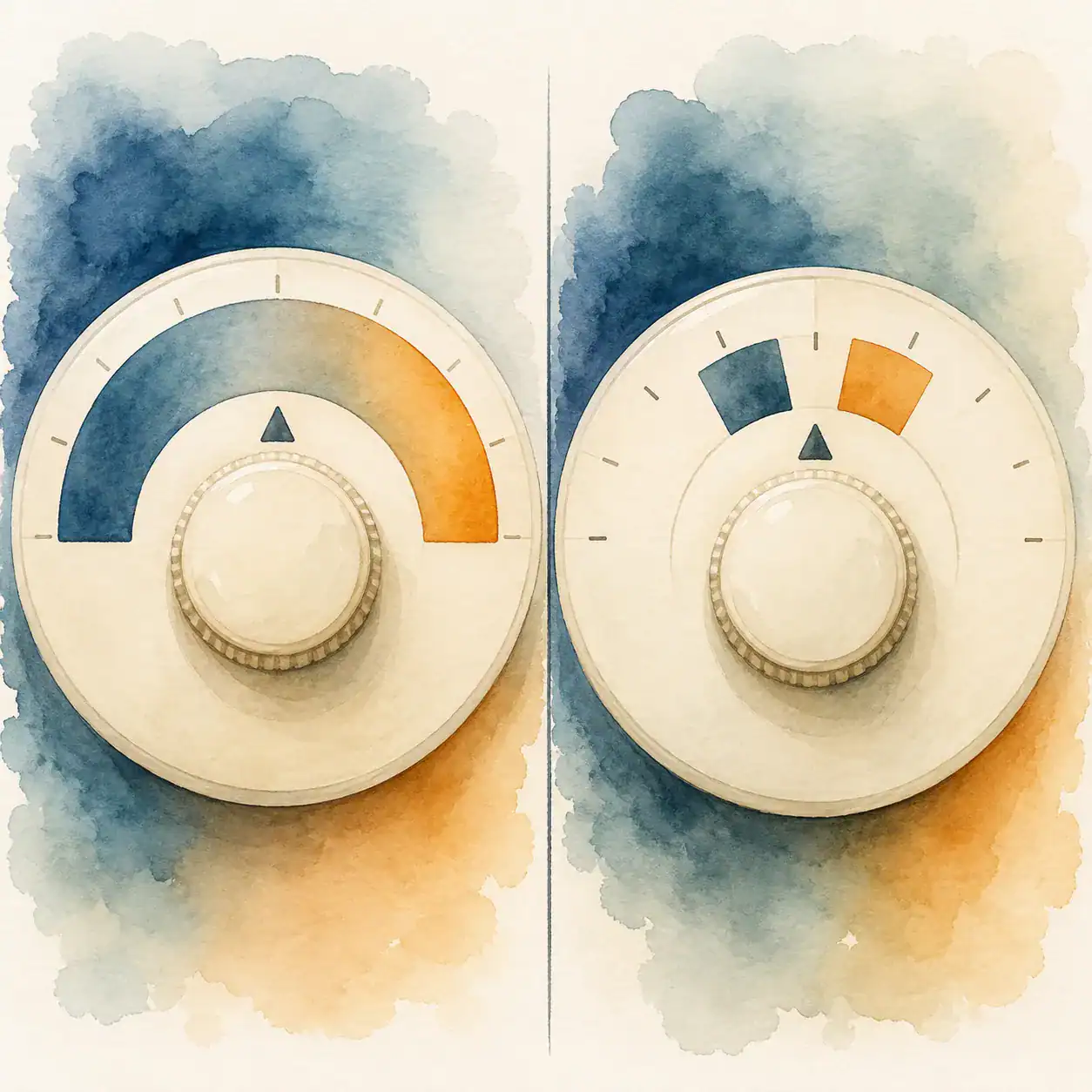
Think of the body’s window for deep, restorative sleep like a thermostat range. When the range is wide, you can handle slight variations and still stay in the zone. After 50, that range narrows. The zone becomes easier to leave and harder to return to. That is not failure. That is physiology requiring better conditions, not more effort.
The Melatonin Problem
Melatonin is not a sleep sedative. It is a timing hormone. It tells the body’s clock what time it is. And after 50, two things happen to it that most people do not know.
First, melatonin production declines with age. The pineal gland becomes less responsive to the light-dark cycle that triggers its release. Evenings that used to produce a strong melatonin signal now produce a weaker one.
Second – and this is the one I found more useful in practice – the signal is sensitive to interference in ways that compound. Mariana Figueiro’s research shows that just two hours of screen use at maximum brightness is enough to suppress normal nighttime melatonin release. Casey Means cites evidence that even typical indoor room light at 200 lux delays melatonin release by 90 minutes and reduces pre-sleep melatonin levels by over 70 percent. For a younger adult, this is inconvenient. For someone over 50 working with a weaker signal to begin with, it can be the difference between crossing into deep sleep and not.
What helped me was treating melatonin less as something to supplement and more as something to protect. The signal was there. I just needed to stop overriding it.
Growth Hormone, Deep Sleep, and the Repair Window
One of the reasons deep sleep matters more after 50, not less, is growth hormone. Nearly all human growth hormone – the body’s primary tissue repair and regeneration signal – is released during the deep slow-wave stages of sleep, particularly in the first major sleep cycle. Michael Breus’s research puts this precisely: deep sleep is when the pituitary gland releases peak growth hormone, the body’s primary fat-burning and repair signal. Without sufficient deep sleep, growth hormone drops and the body routes incoming calories toward fat storage rather than burning them.
After 50, deep sleep is already declining. Every input that further fragments or delays it – a late meal, a warm room, screens running late, cortisol not falling – compounds the deficit. The repair window gets smaller. And the consequences show up not just in tiredness but in recovery, body composition, and over time, in cognitive health.
What Changed When I Fixed the Conditions
I want to be honest about the sequence here. I fixed my eating window first. The sleep followed. I did not set out to address sleep at all.
By May 2024, roughly six weeks after shifting to 18:6 eating, something I had not felt since my twenties returned: waking up naturally, ahead of the alarm, not groggy. By 2025, my tracked sleep quality data showed 57 nights of 9 or 10 out of 10. Without a single sleep aid, and without doing anything I would describe as a sleep intervention.
What I had done was change the conditions. I had moved the eating window earlier, which meant insulin was lower when I went to bed, which meant melatonin could rise without competition. I had cooled the bedroom. I had stopped screens at 8pm. I had started taking morning light early. None of it targeted sleep directly. All of it changed the hormonal environment in which sleep was trying to happen.
The biological shift after 50 is real. But the degree to which it disrupts your nights is not fixed. It depends heavily on whether the conditions the body needs to cross into restorative sleep are being met – or whether the modern inputs we treat as normal are, night after night, preventing that from happening.
This is not an inevitability. It is a set of conditions. And conditions can change.
So if the waking at 3am is not a sleep disorder – what is your body actually trying to tell you at that hour?
Educational content only, not medical advice. If you’re experiencing significant sleep disruption or symptoms that concern you, please speak to your GP.
The 7-Day Sleep Reset covers the practical steps for improving sleep conditions one at a time – including the hormonal ones.
Get the 7-Day Sleep ResetSources
- Sara Gottfried – cortisol and HPA axis changes with age
- Peter Liu et al. – sleep restriction and testosterone decline
- Matthew Walker – sleep restriction and hormonal research
- Till Roenneberg, Ludwig Maximilian University – circadian rhythm research
- Jeanne Duffy – circadian vulnerability to sleep disruption in older adults
- Mariana Figueiro – screen use and melatonin suppression
- Casey Means – indoor light exposure and melatonin suppression
- Michael Breus – growth hormone release during deep sleep
More in sleep-science
- What 57 Nights of Perfect Sleep Actually Did to My Biomarkers
- The Sleep Myth That Keeps Over-50s Exhausted: Why “Catching Up” at the Weekend Does Not Work
- The Bedroom Habits That Ruined My Sleep for Years (And the Four That Fixed It)
- “I Sleep 8 Hours But Still Feel Exhausted”: Why the Hours Are Not the Problem
