

The short version: Sleep disruption in perimenopause is not vague “hormonal changes.” It is a specific biological mechanism: declining progesterone reduces GABA (the brain’s calming signal), declining oestrogen disrupts the circadian-melatonin connection, and hot flushes directly cause waking at the most fragile point of the night. Understanding the mechanism changes what you look for and what actually helps.
I have not lived this one. My sleep disruption came from different biological inputs. But the women in my audience face this, it intersects directly with the metabolic framework I write about, and writing around it because I am male would be a strange form of silence. So this is me going carefully through the research, putting it in plain English, and connecting it to the broader framework where it fits. What I cannot give you is the first-person story. What I can is the mechanism.
The Numbers First
More than 50 percent of women experience significant sleep problems during the menopausal transition. That is a prevalence that demands attention rather than the resigned “it’s just part of it” framing it often receives. Fiona Baker’s research at SRI International puts the clinical picture more precisely: 26 percent of perimenopausal women qualify for a clinical diagnosis of insomnia – substantially higher than premenopausal women at 13 percent and postmenopausal women at 14 percent. Peak insomnia prevalence across menopausal stages occurs during perimenopause itself, not after.
Patrick McKeown cites risk data showing the risk of obstructive sleep apnoea increases by around 4 percent with each year after perimenopause begins, and sleep disturbances affect 40 to 60 percent of menopausal women overall. A 2026 research review from Jing Luo and Song Lin found that insufficient sleep – under six hours – roughly tripled depression risk in perimenopausal women in both urban and rural groups. The sleep disruption is not a minor side effect of the menopausal transition. It is one of its most significant health consequences.
The Three Hormonal Mechanisms
Mindy Pelz’s work identifies five hormones that govern sleep quality: cortisol, melatonin, insulin, oestrogen, and progesterone. During perimenopause, declining sex hormones force the remaining three to carry extra load – making sleep architecture far more fragile than in premenopausal years.
The progesterone-GABA connection. Progesterone activates GABA receptor sites in the brain. GABA is the neurotransmitter most directly responsible for slowing neural activity and enabling the transition into sleep. As progesterone declines during perimenopause, GABA levels drop. The clinical result is the classic wired-but-exhausted experience: physically tired but unable to switch off the mind at bedtime. This is not anxiety in the psychological sense. It is a direct neurochemical consequence of progesterone withdrawal.
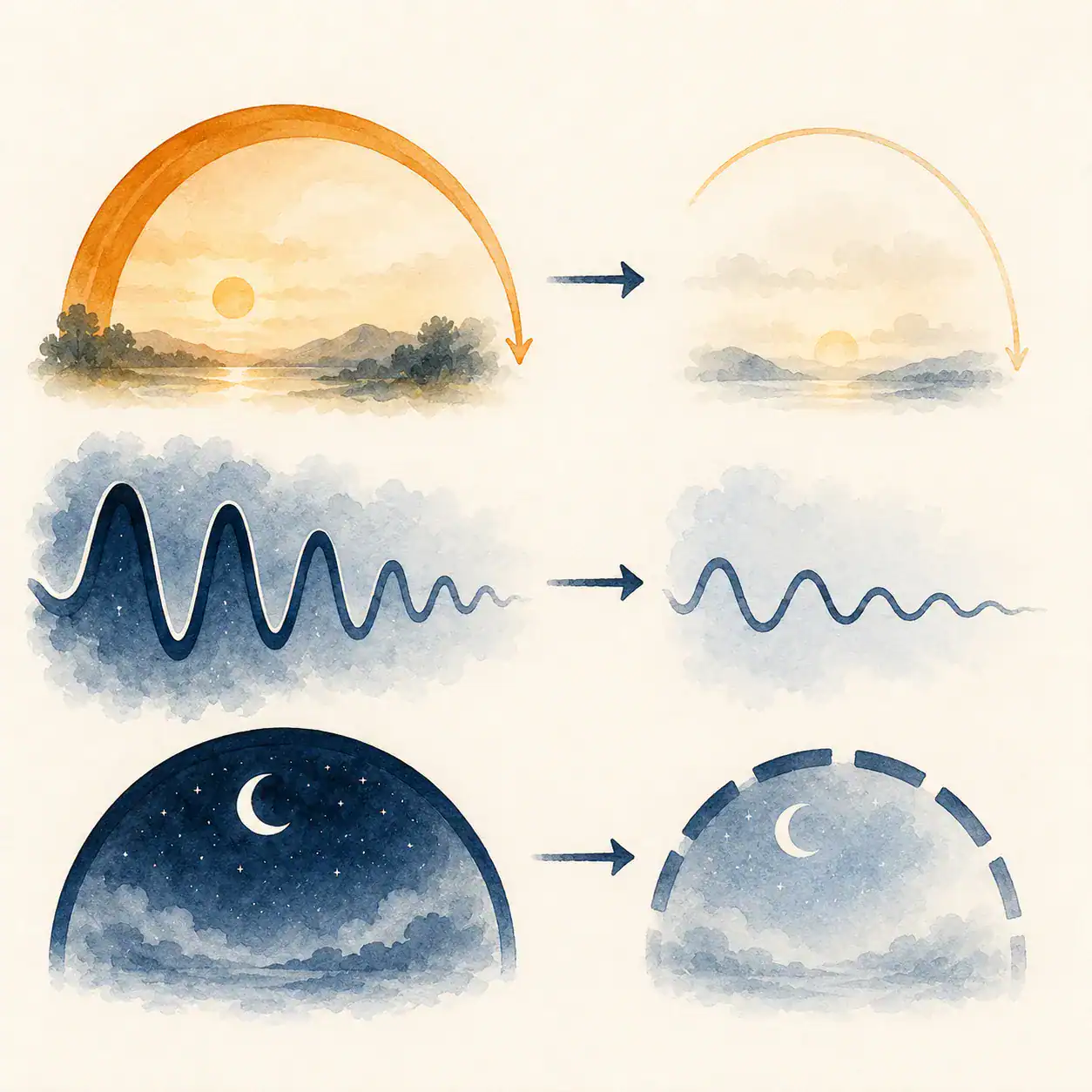
Oestrogen and the circadian melatonin pathway. A 2021 peer-reviewed study cited by Mindy Pelz found that oestrogen decline disrupts melatonin production by impairing communication between the pineal gland and the suprachiasmatic nucleus – the brain’s master clock. This causes circadian dysregulation in over 50 percent of menopausal women and explains the 2am waking pattern that many women describe. It is not insomnia in the primary sense. It is a disrupted circadian-melatonin connection producing irregular sleep architecture at the fragile second-half point in the night.
Hot flushes as direct waking events. Fiona Baker’s research with colleagues is precise: 69 percent of nocturnal hot flushes in perimenopausal women are directly associated with awakenings from sleep. Hot flushes are not merely a discomfort that happens to occur at night – they are mechanistically causing fragmented sleep. The magnitude of sleep disruption is proportional to the number of nocturnal hot flushes. This matters because the intervention for hot flushes (lifestyle, hormonal support) is different from the intervention for difficulty initiating sleep. Separating the mechanisms allows for more targeted responses.
The Insulin-Sleep Connection in Women Over 40
The framework I use for my own sleep – the eating window, the circadian anchor, the cortisol taper – is not uniquely male. Research from the ZOE study found that going to sleep with elevated glucose levels or after a large glucose spike is linked to insomnia in postmenopausal women specifically. The evening glucose crash that wakes someone at 3am with a racing heart is a common perimenopausal presentation that is frequently misidentified as anxiety or a hot flush.
Closing the eating window earlier, which lowers the glucose level at sleep onset, is relevant in perimenopause for the same reason it is relevant for men over 50: the melatonin-insulin competition is the same biology, the consequences are the same, and the intervention is the same. The hormonal layer is different, but the metabolic framework underneath it is shared.
What the Evidence Says Helps
The clearest evidence base for perimenopausal sleep is for cognitive behavioural therapy for insomnia (CBT-I), which Dr Jade Wu and others have shown matches sleeping pills in the short term and outperforms them at three-year follow-up. This is a meaningful finding for a population that is often offered pharmacological options first.
The lifestyle interventions that the research supports – earlier eating window, reduced evening light, consistent wake time, cooler bedroom, morning light exposure – are the same as those that improve sleep generally. They do not address the progesterone-GABA or oestrogen-melatonin mechanisms directly, but they reduce the additional burden on those systems and improve the baseline conditions in which they are trying to function.
For hormonal support, this is a conversation for a GP with up-to-date knowledge of the menopause guidance. The evidence base for hormone replacement therapy in managing sleep disruption during perimenopause is stronger than many GPs’ referral patterns suggest, and NICE updated its guidance in 2023. If you have been experiencing significant perimenopause-related sleep disruption and have not yet had that conversation, it may be worth initiating.
Educational content only. Not medical advice. If you are experiencing significant sleep disruption associated with perimenopause, please speak to your GP or a menopause specialist.
The 7-Day Sleep Reset covers the lifestyle inputs that support sleep quality regardless of hormonal context – eating window, circadian anchor, light environment, bedroom conditions.
Get the 7-Day Sleep ResetIf the wired-but-exhausted feeling at bedtime has a specific neurochemical explanation – and it does – does knowing that change what you would try first?
More in sleep-science
- What 57 Nights of Perfect Sleep Actually Did to My Biomarkers
- The Sleep Myth That Keeps Over-50s Exhausted: Why “Catching Up” at the Weekend Does Not Work
- The Bedroom Habits That Ruined My Sleep for Years (And the Four That Fixed It)
- “I Sleep 8 Hours But Still Feel Exhausted”: Why the Hours Are Not the Problem
