

The short version: Screen light in the evening does not just make you feel less sleepy. It chemically suppresses melatonin, delays the body clock by hours, and compounds in a person over 50 whose melatonin signal is already weaker than it was at thirty. The disruption is more significant than most people realise, and the fix is simpler than most people expect.
I stopped screens at 8pm, not because I read something about blue light and thought it seemed sensible, but because after I did it and saw what happened to my sleep quality, I could not ignore the connection any longer.
Before the change: screens running until ten or eleven most nights, television on in the background, phone beside the bed. Sleep quality tracking around 6 to 7 out of 10. After the change, within about two weeks: consistently 8 to 9. The bedroom temperature had changed too, and the eating window, so I cannot isolate the screen curfew as the single variable. But the pattern held every time I let the habit slip and ran screens late. The next night was reliably lighter.
What Screen Light Actually Does
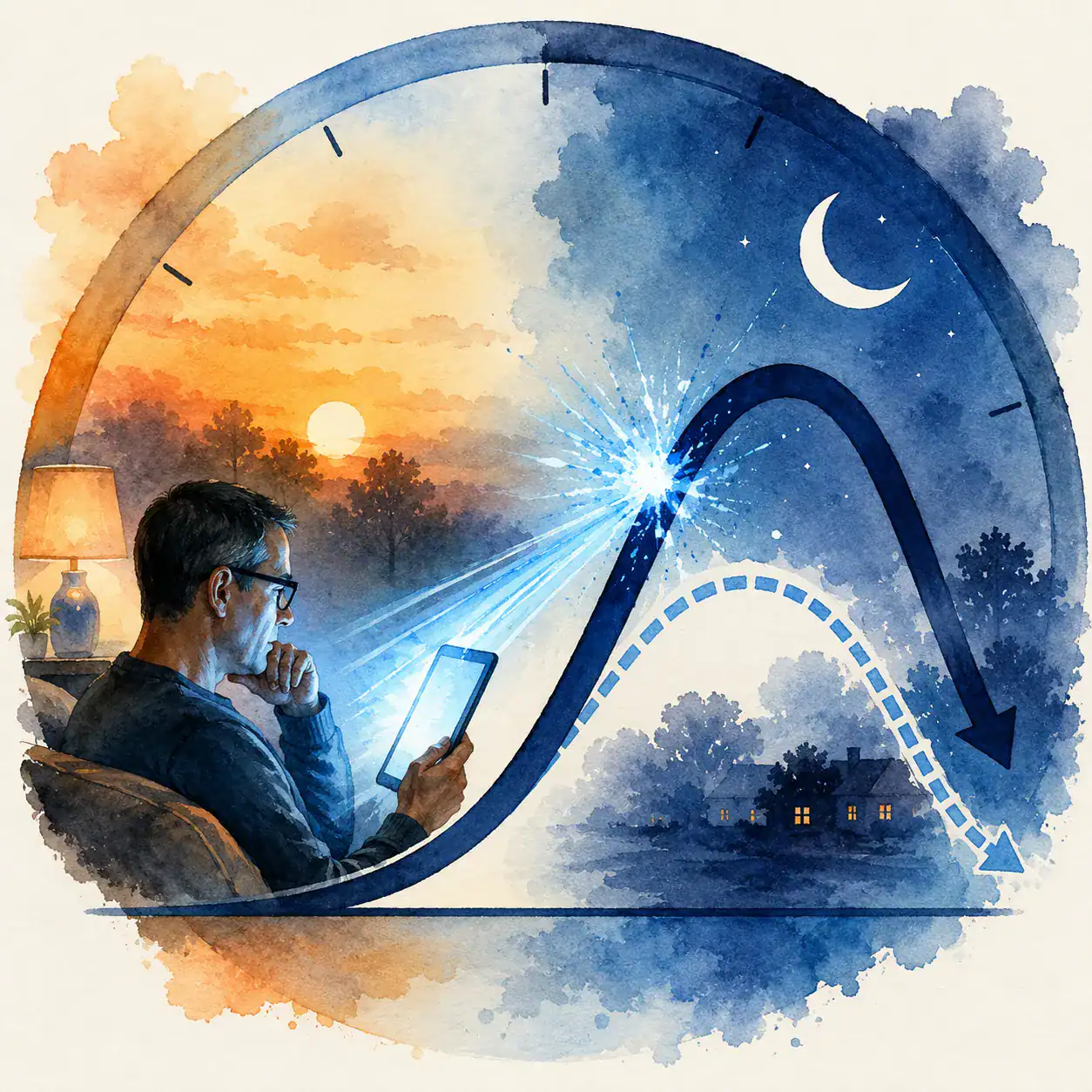
The eye contains specialised photoreceptors called intrinsically photosensitive retinal ganglion cells. They respond specifically to short-wavelength (blue) light and connect directly to the suprachiasmatic nucleus – the master clock in the hypothalamus. When those cells detect blue light, they signal to the brain: it is daytime. The system that drives melatonin production receives a direct override instruction.
Matthew Walker’s research makes the scale of this effect concrete: blue LED screens suppress melatonin over 50 percent and delay its rise by up to three hours. Two hours of iPad use before bed creates the biological equivalent of flying westward across three time zones. Mariana Figueiro’s group showed that just two hours of screen use at maximum brightness is enough to suppress the body’s normal nighttime melatonin release entirely.
Casey Means cites evidence that typical indoor room light at 200 lux – which is less bright than most lit living rooms – delays melatonin release by 90 minutes and reduces pre-sleep melatonin levels by over 70 percent. You do not need a smartphone screen for this to happen. The lamp in the corner of your sitting room is doing some of the same work.
Why It Hits Harder After 50
Melatonin production declines with age. The pineal gland becomes gradually less responsive to the light-dark signal that triggers melatonin release, which means the signal that the body’s clock receives at night is already weaker than it was at thirty. The margin for disruption is smaller.
This creates a compounding problem. A younger adult with a robust melatonin signal can absorb some evening screen exposure and still cross the threshold into sleep onset without significant delay. An adult over 50 with a reduced signal is starting from a position where any suppression may be enough to prevent the threshold from being crossed at all.
The practical consequence is that the same evening habits that produced adequate sleep at thirty-five do not produce the same result at fifty-three. Nothing dramatic has changed. The bedroom is the same, the routine is the same. But the biology has shifted, and the margin of error for light exposure has narrowed accordingly.
Think of it like this: the screens are sending hazard lights through a system that was once robust enough to filter them and route melatonin anyway. After 50, the filter is thinner. The hazard lights get through with less resistance, and the system interprets them as a signal that it is not yet time to sleep.
What I Changed and When
8pm screen curfew. No television, no phone, no laptop after that point. In the early weeks, this felt earlier than felt sensible – what on earth do you do between 8pm and 10pm without screens? The answer, it turned out, was reading. A book with a lamp rather than a ceiling light. A walk if the evening was mild. A conversation. Things that were no less relaxing than the screen habits they replaced, and that did not require the blue light signal.
The lamp situation mattered more than I initially appreciated. Moving from overhead ceiling lighting to a single lamp with a warm-toned bulb in the evening made a measurable difference. Casey Means’s research on indoor light at 200 lux applies to standard UK sitting room lighting. Dimming that earlier in the evening, removing the overhead lights at 8pm even if screens were already off, created an earlier melatonin signal.
Within two weeks of the combined change – screen curfew plus dimmer lighting – my sleep quality scores shifted noticeably. By the time I tracked my 57 nights of 9 to 10 in 2025, the evening light routine was entirely normal. It stopped feeling like a sacrifice once the sleep on the other side of it became reliable.
The Alarm Screen Problem
The other habit worth naming: a phone beside the bed as an alarm clock. Even if it is face-down and on silent, it is there. And the habit of checking it – once, quickly, just to see the time – in a 3am waking introduces exactly the light signal that prevents return to sleep at the most fragile point of the night.
A standard alarm clock – non-illuminated, or with a very dim face – removes this entirely. It is one of the lower-effort changes in the whole sleep environment that produces a surprisingly reliable effect. The temptation to pick the phone up is connected to the phone being present. If it is in another room, the temptation does not arise.
I moved my phone to another room. It was a small inconvenience for three days, and then not at all.
If you moved your phone to another room tonight – not as a permanent decision, just to see – what would be different about tomorrow morning?
Educational content only. Not medical advice. Speak to your GP if you are experiencing significant sleep disruption.
Day two of the 7-Day Sleep Reset covers the light environment – evening light, screen curfew, and the alarm clock situation.
Get the 7-Day Sleep ResetMore in sleep-science
- What 57 Nights of Perfect Sleep Actually Did to My Biomarkers
- The Sleep Myth That Keeps Over-50s Exhausted: Why “Catching Up” at the Weekend Does Not Work
- The Bedroom Habits That Ruined My Sleep for Years (And the Four That Fixed It)
- “I Sleep 8 Hours But Still Feel Exhausted”: Why the Hours Are Not the Problem
