

The short version: Sleep changes in men over 50 are driven by specific biological shifts – testosterone decline, cortisol elevation, reduced deep sleep, and a circadian window that has moved earlier. These are not random deterioration. They are predictable, and the inputs that make them worse are also predictable. This is what my data showed, and what changed it.
I am 53. Male. I spent most of my late forties not sleeping terribly, not sleeping well – the kind of middling sleep that does not flag on any GP blood test and that I had entirely normalised as “what happens when you get older and run a business.”
Tired by 3pm. Not quite sharp enough in meetings. Craving carbohydrates from mid-afternoon in a way I could not fully explain. Not dramatic enough to seek help. Just the background noise of being in my fifties.
It was not age. It was conditions. And when the conditions changed – through changes to my eating window, my light environment, my bedroom temperature, and my morning routine – the sleep changed too. Fifty-seven nights of 9 to 10 out of 10 in 2025. WMTWL-EVID-0177 is in the records if you want the numbers.
Here is what was actually happening, and why it tends to look the way it does for men specifically.
The Male Biology of Sleep After 50
There is a direct relationship between testosterone and sleep architecture that most men over 50 are never told about. Matthew Walker’s group at UC Berkeley found that five hours of sleep per night for just five nights reduces testosterone in young healthy men to levels equivalent to ten years of accelerated ageing. Max Lugavere cites a similar finding: one week of restricted sleep cut testosterone by 10 to 15 percent – the equivalent of ageing five to ten years in seven days.
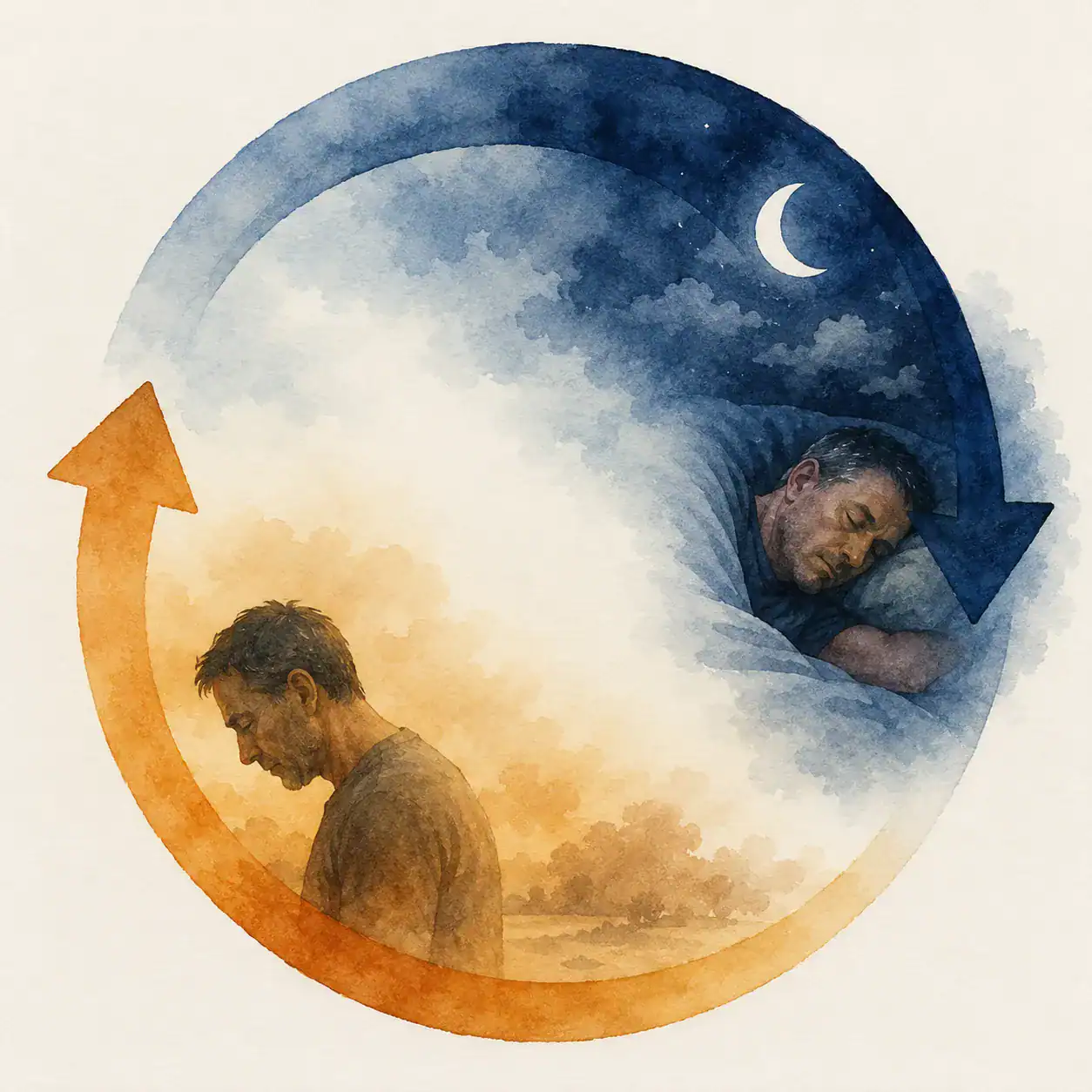
The feedback loop runs in both directions. Lower testosterone impairs sleep quality, particularly the deep slow-wave stages. Poor sleep quality lowers testosterone further. If you arrive at 50 with both a modest testosterone decline from natural ageing and a sleep pattern that has been quietly degrading for years, the two conditions are compounding each other in a direction that is easy to misread as simply “getting older.”
The cortisol piece matters too. Sara Gottfried’s research shows cortisol levels rise structurally by approximately 20 percent between the ages of 50 and 89 – independent of stress or lifestyle. For men specifically, this elevated cortisol baseline raises the testosterone-to-cortisol ratio in the wrong direction. The anabolic signal (testosterone) weakens relative to the catabolic signal (cortisol), creating a hormonal environment that accelerates muscle loss and fat gain and simultaneously makes deep, restorative sleep harder to maintain.
This is not catastrophising. It is the straightforward biology. And it responds to the right inputs.
The Male Sleep Pattern Over 50 Specifically
Men over 50 are disproportionately affected by sleep-disordered breathing. Patrick McKeown cites obstructive sleep apnoea prevalence data showing it affects 26 percent of men aged 30 to 49, rising to 43 percent of men aged 50 to 70. Most go undiagnosed. A man who snores heavily, wakes frequently, experiences morning headaches, or feels unrested despite apparent hours of sleep should discuss sleep apnoea with his GP, because the cardiovascular and metabolic consequences of untreated OSA are significant.
I do not have sleep apnoea. But I mention it here because it is the most commonly missed male sleep issue over 50, and because several of the symptoms I described – not terrible, not good, a kind of background tiredness – overlap with mild-to-moderate OSA presentation enough that it is worth naming directly.
For men whose sleep disruption is not apnoea-related, the pattern tends to involve: difficulty reaching deep slow-wave sleep (the restorative first third of the night), earlier natural waking as the circadian window shifts, and the afternoon energy crash that comes from growth hormone not being properly released during insufficient deep sleep.
What the Data Said About the Afternoon Crash
The 3pm energy dip I had normalised for years was not an inevitable feature of my metabolism. It was a downstream consequence of insufficient deep sleep from the night before.
Michael Breus’s research connects this directly: deep sleep is when the pituitary gland releases peak growth hormone – the body’s primary fat-burning and repair signal. Without sufficient deep sleep, growth hormone drops and the body routes incoming calories toward fat storage rather than energy, while leaving the afternoon with less metabolic fuel available. The crash was the body experiencing the energy consequence of the previous night’s sleep architecture.
Once the conditions for deep sleep improved – earlier eating window, cooler room, consistent wake time, morning light – the afternoon crash largely disappeared. Not because I had specifically targeted it, but because the growth hormone was releasing properly at night and the body had more to work with through the day.
The Metabolic Cascade for Men Specifically
This matters whether you have been told anything is wrong metabolically or not. The constellation of symptoms I described – not terrible sleep, afternoon energy dip, difficulty maintaining body composition despite doing the right things, occasional 3am waking – has a common upstream mechanism in most men over 50: insulin resistance combined with cortisol elevation combined with reduced deep sleep combined with the testosterone-sleep feedback loop.
None of these are separate diagnoses. They are one metabolic state expressing itself in different symptoms. And the inputs that address that state – food timing, circadian anchoring, light environment – tend to improve all of the symptoms, not just the one you started trying to fix.
Which is exactly what happened to me. I fixed the eating window for metabolic reasons. The sleep followed. The afternoon crash went. The mood stabilised. The blood test data – HbA1c from 47 to 37, CRP from 6.2 to 1.0 – reflected the same shift. One root cause, multiple expressions, one direction of travel.
If the afternoon crash is not inevitable – if it is the body working with insufficient overnight fuel – what would it take to test whether a better sleep window changes it?
Educational content only. Not medical advice. If you are experiencing symptoms that may suggest sleep apnoea, persistent fatigue, or significant sleep disruption, please speak to your GP.
The 7-Day Sleep Reset was built from one man’s data, and that man is in his fifties. The habits are practical, the order is logical, and nothing in it requires superhuman discipline.
Sources
- Walker, M. (cited in expert records) – UC Berkeley, sleep restriction and testosterone.
- Lugavere, M. (cited in expert records) – sleep restriction and testosterone decline.
- Gottfried, S. (cited in expert records) – cortisol and ageing.
- McKeown, P. (cited in expert records) – obstructive sleep apnoea prevalence data.
- Breus, M. (cited in expert records) – deep sleep and growth hormone release.
- WMTWL Personal Evidence: WMTWL-EVID-0177 (57-night sleep quality dataset, 2025).
- WMTWL Personal Moment: WMTWL-MOM-193.
More in sleep-science
- What 57 Nights of Perfect Sleep Actually Did to My Biomarkers
- The Sleep Myth That Keeps Over-50s Exhausted: Why “Catching Up” at the Weekend Does Not Work
- The Bedroom Habits That Ruined My Sleep for Years (And the Four That Fixed It)
- “I Sleep 8 Hours But Still Feel Exhausted”: Why the Hours Are Not the Problem
