

The short version: Poor sleep after 50 is not mainly about the hours – it is about the conditions the body needs to cross into deep, restorative sleep. Those conditions changed in your forties. Most sleep advice was written for a twenty-five-year-old. This article is written from data going back to 2012, 57 documented nights of 9-10 out of 10 sleep quality, and the pattern I spotted only by accident.
For most of my forties, I slept the way you probably sleep: not terribly, not well. In bed by eleven, awake by half six, unremarkable eight hours on paper. And yet. Foggy by three in the afternoon. Craving carbs by four. A kind of low-level tiredness I had genuinely assumed was just what getting older felt like.
I did not set out to fix my sleep. I fixed something else entirely.
Boxing Day 2023, I changed what I ate and when I ate it. Six weeks in, something happened that had not happened since my twenties. I woke up at 5:47am one morning, before the alarm, and I was not groggy. I was not hunting for coffee before I could think. I was just… awake. Ready. The room was pitch black. The temperature was 17 degrees. And I had not done a single thing with sleep deliberately.
That was the first signal. The 57 nights came later – tracked through 2025, rated 9 or 10 out of 10 on quality, without a single sleep aid. By then I had a reasonable idea of what had actually changed. This article is my attempt to put it in plain English.
If you are over 50 and sleeping badly, the information below will not look like most sleep advice. That is the point.
Why Sleep Gets Harder After 50 – The Part Nobody Explains Properly
The common answer is that sleep “naturally deteriorates with age.” Which is true, technically, but it is the kind of true that stops you looking for anything more useful.
Here is what is actually happening.
By your mid-to-late thirties, the amount of deep sleep you get – the slow-wave, genuinely restorative stage – starts to decline. By the time you are in your mid-fifties, you may be getting 60 to 70 percent less deep slow-wave sleep than you did as a teenager. Professor Matthew Walker, whose research I’ve read at length, puts this very directly: deep sleep decline begins in the mid-to-late thirties, two decades before most people start worrying about their cognitive health. Patrick McKeown cites a similar figure: by mid-to-late forties you are already down to around 60 to 70 percent of the deep sleep you once had, and by 70 it may be 80 to 90 percent less.
The consequence is not just tiredness. Deep sleep is when your brain runs its internal cleaning system. Maiken Nedergaard at the University of Rochester identified how this works: during deep non-REM sleep, brain cells actually shrink, creating space for cerebrospinal fluid to flood through and sweep out toxic waste products, including the amyloid proteins linked to Alzheimer’s. Just one night of sleep deprivation produces measurable amyloid accumulation. This is not a distant risk – it is what happens to the brain on Tuesday after a rough Monday night.
There is also the hormonal shift. After 50, cortisol levels rise structurally, with Sara Gottfried’s research suggesting cortisol increases approximately 20 percent between the ages of 50 and 89 simply as a function of ageing. Not because you are stressed. Just because the system is running hotter. And cortisol, as I will come to in a moment, is one of the main reasons people over 50 lie awake at 3am.
The third change is circadian. Jeanne Duffy’s work on ageing and circadian timing is precise about this: with healthy ageing, the window during which the body wants to sleep and the window during which it can sustain sleep both narrow and shift. Older adults become more vulnerable to sleep disruption in the second half of the night regardless of what they do. The internal clock runs earlier. The temperature signals change. Melatonin production shifts.
None of this is your fault. But it does mean that the sleep advice designed for someone at thirty does not automatically apply to someone at fifty-three.
What Was Actually Happening in My Nights
I look back now and I can see the pattern clearly. I had the hours. I did not have the conditions.
My eating window closed late. I was grazing through the evening, which meant my insulin was still elevated when I lay down. Eating within two to three hours of sleep – as confirmed by Federica Amati at ZOE – suppresses melatonin production and prevents proper entry into deep and REM sleep, because the body reads food signals as wakefulness signals, not sleep ones. I was effectively telling my nervous system to stay on duty.
My bedroom was too warm. The screens were on until late. The light from them was doing more than I understood: Mariana Figueiro’s research shows that just two hours of screen use at maximum brightness is enough to suppress the body’s normal nighttime melatonin release.
And my cortisol was not dropping the way it should. Cortisol follows a predictable daily pattern – high in the morning, gradually falling through the day, reaching its lowest point around midnight before melatonin takes over. When that pattern is disrupted, and mine was, the brain stays alert at the wrong time. You might not describe yourself as stressed. But the chemistry is still running a mid-grade stress programme through the early hours. Which is exactly what a 3am waking looks like from the inside.
None of those were sleep problems in isolation. They were downstream signals of a metabolic state that was not giving the body permission to rest.
The Seven Changes That Actually Mattered
I want to be straightforward with you: I did not set out to do seven things. I set out to eat better and eat in a narrower window. The sleep followed. The seven things I am about to describe are what I can point to in retrospect.
1. The eating window closed earlier
Moving to an 18:6 eating pattern meant my last meal was finishing by early evening. Satchin Panda’s circadian research at the Salk Institute is relevant here: eating within a 10-hour window without any other dietary changes produces reductions in inflammation and improvements in sleep within weeks. The mechanism is partly direct (no active digestion when trying to sleep) and partly indirect (insulin falls earlier, melatonin can rise naturally). Panda’s team found this works even when total calories stay identical.
The body interprets a late meal as a wakefulness cue. Close the window earlier, and the cue disappears. This was the single change that unlocked the most.
2. The bedroom got darker and cooler
Room temperature 17°C. Blackout. These are not novel recommendations, but the evidence behind the temperature piece is worth understanding. Susanna Søberg’s research found that sleeping in a room at 19°C for one month produced a marked increase in brown fat activity and improved insulin sensitivity. The body’s core temperature needs to fall to initiate and sustain deep sleep. A warm bedroom fights that process directly.
The darkness piece matters for a different reason: even low-intensity indoor light suppresses melatonin. Casey Means cites research showing that exposure to typical indoor room light before bedtime delays melatonin release by 90 minutes and reduces pre-sleep melatonin levels by 71 percent.
3. Screens off before 8pm
Blue light from screens tells the suprachiasmatic nucleus – the master clock in the hypothalamus – that it is still daytime. Matthew Walker’s group has shown that blue LED screens suppress melatonin by over 50 percent and delay its rise by up to three hours. Two hours of iPad use before bed creates the biological equivalent of a three-hour westward time shift.
I treat the screen curfew as a circadian anchor, not a sleep remedy. The goal is to stop overriding the signal that melatonin is supposed to receive.
4. A consistent sleep window (and wake time above all)
Nick Littlehales, who has worked with elite sports teams on sleep architecture, is clear that a consistent fixed wake time is the single most powerful tool for improving sleep quality. Not the bedtime – the wake time. It anchors the body clock. Everything downstream adjusts around it.
Patrick McKeown adds something I have seen play out in my own data: falling asleep between 10pm and 11pm appears to be the sweet spot for both sleep quality and heart health. Going to bed later starves you of the deep-sleep phases that front-load the first half of the night. This connects to Professor Debra Skene’s circadian research: 10pm to 6am beats 1am to 9am even when the hours are identical, because timing affects virtually every metabolic and physiological process. I experienced this directly – eight and a half hours starting at 1am left me foggy in a way that seven hours starting at 10pm did not.
5. Morning light, quickly
Andrew Huberman’s work on the cortisol awakening response is practical and specific: morning light exposure within one hour of waking anchors the daily cortisol pulse, sets circadian timing, and modulates alertness and mood for the entire day. From Will Bulsiewicz’s research, morning sunlight within 30 minutes of waking also boosts cortisol by over 50 percent at the right time – meaning the morning – which then allows it to fall correctly through the day and reach its low point at night.
I started walking outside in the morning without sunglasses. Not always for long. But consistently. The cortisol awakening response worked with me rather than against me once the light signal was going in at the right end of the day.
6. The gut-sleep axis
This one took me longer to understand. Shawn Stevenson’s research summary notes that the gut contains at least 400 times more melatonin than the pineal gland in the brain, with enteroendocrine cells in the gut producing melatonin independently. The gut has its own circadian clock. Disrupt the gut – through ultra-processed food, through erratic meal timing – and you disrupt the internal melatonin system upstream of the brain entirely. Fixing what I ate changed my gut microbiome. Some of what improved in my sleep was coming from there.
7. The fasting connection
There is a direct relationship between insulin, melatonin and sleep that most sleep guides do not mention. Mindy Pelz’s work is clear on this: insulin and melatonin operate inversely. When melatonin is rising at night, insulin sensitivity is lower. Eating high-carbohydrate meals after dark when melatonin is rising impairs glucose clearance, promotes fat storage, and disrupts sleep by keeping the metabolic system active. Extended fasting periods during the day give the system long enough to reset. My sleep quality data across 2025 showed the relationship was real: the nights after clean fasting days were consistently better than the nights after grazing days, even when the hours were the same.
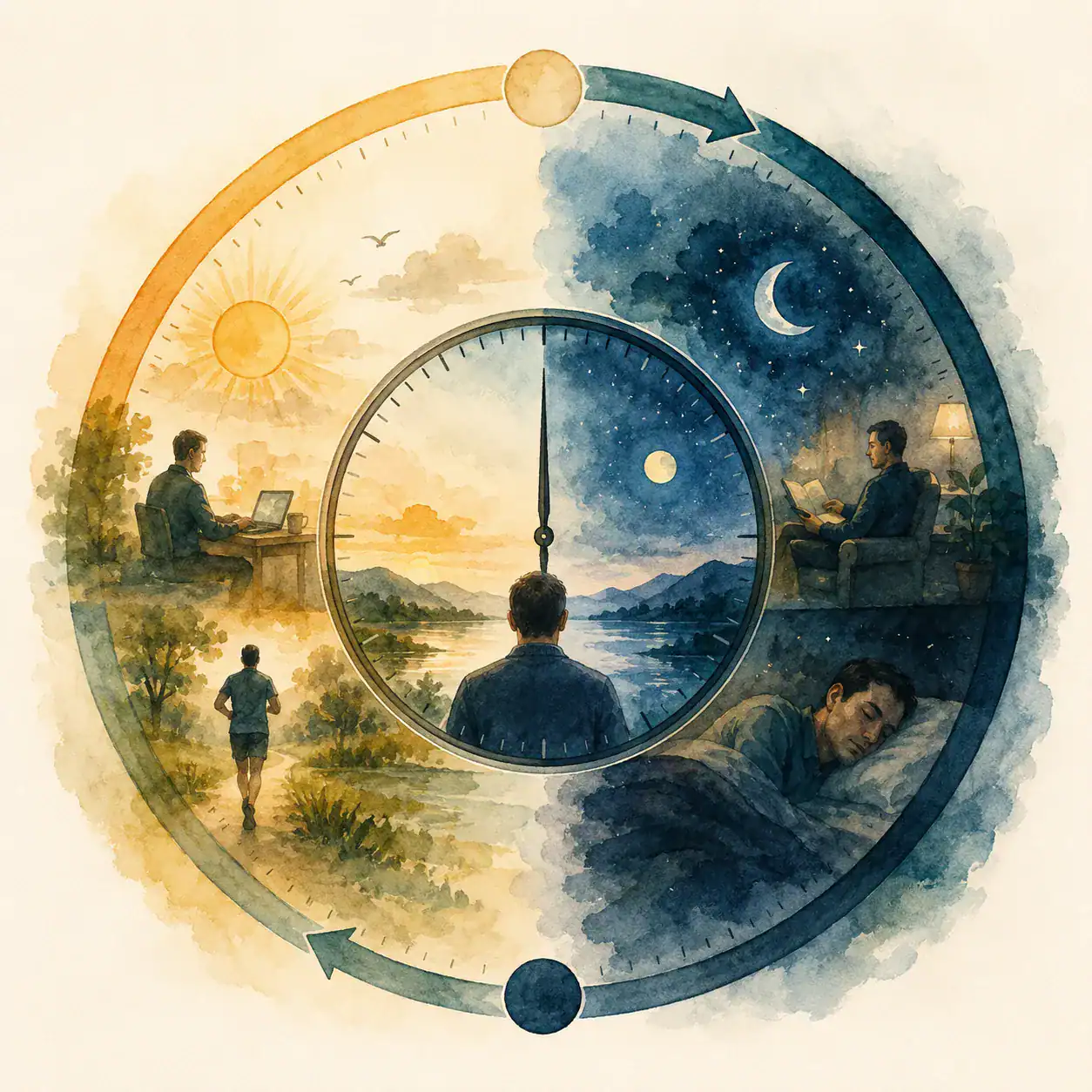
The Metabolic Cascade: One Mechanism, Two Entry Points
Whether you have a diagnosis of something or not, the mechanism under poor sleep after 50 is often the same: the body’s circadian regulation – the internal clock that governs cortisol, melatonin, insulin sensitivity, and deep sleep architecture – has been disrupted by a combination of food timing, light exposure, and the natural hormonal shifts of midlife.
This matters whether you are a man in his late fifties whose doctor has mentioned pre-diabetes, or a woman in her early forties who has started waking at 3am without understanding why. The biology does not care which route brought you here. The same mechanisms are running in both directions.
The enemy – to use the Carr framing I find genuinely useful – is not sleep itself. Sleep is fine. The enemy is the set of modern inputs that are telling your body’s clock that it is not time to sleep when it very much is. Light too late, food too late, cortisol not dropping, melatonin not rising. That is what a bad night looks like from the inside of the chemistry.
What the 57 Nights Actually Required
I tracked 57 nights of 9 or 10 out of 10 sleep quality through 2025. WMTWL-EVID-0177 in my data records. No sleep aids. No supplements.
What they required:
Not more willpower at bedtime. Not a better mattress. Not the right app.
They required a metabolic environment in which sleep was actually possible. Insulin low enough by the evening. Melatonin able to rise without light interference. Core body temperature able to fall in a cool room. Cortisol following its correct pattern because the morning light signal was going in at the right time.
The waking-at-5:47am moment in May 2024 – that was not a sleep hack working. That was what happens when you remove the things that were blocking sleep from doing what it wanted to do anyway. The body remembered.
Turns out I had not fixed my sleep. I had fixed the things that were breaking it.
A Note on What This Is Not
This is one person’s data. I am 53, male, and my journey into this came through fasting and food quality rather than starting from sleep deliberately. The mechanism may look different for you, particularly if hormonal changes, perimenopause, or medication are factors I do not share. What I can say is that the biology underneath is the same – the circadian system, the cortisol pattern, the melatonin rise, the deep-sleep window. The specific inputs that disrupted mine may not be identical to the inputs disrupting yours. But the direction of travel is almost certainly the same.
If your sleep has changed since your forties, something changed its conditions. The question is which thing.
So what is actually disrupting your sleep – the hours, or the conditions the body needs before it will cross into them?
Educational content only, not medical advice. If you are experiencing significant sleep disruption, unusual fatigue, or symptoms that may indicate sleep apnoea, please speak to your GP before making changes to your diet, fasting pattern, routine, or medication.
If you want a structured way to start noticing your own sleep pattern, the 7-Day Sleep Reset walks through it one step at a time. No pressure, and no need to change everything at once.
Get the 7-Day Sleep ResetFrequently Asked Questions
How does sleep change after 50?
Deep slow-wave sleep declines significantly from the mid-thirties onwards, with some research suggesting adults in their mid-fifties get 60 to 70 percent less deep sleep than they did as teenagers. The circadian window narrows, cortisol levels rise structurally with age, and the timing of melatonin production shifts earlier. These changes make sleep more fragile in the second half of the night.
Why do I keep waking at 3am?
Waking between 2am and 4am is often connected to a cortisol pulse at the wrong time, a blood sugar drop triggering the liver to release glucose, or fragmented sleep architecture from insufficient deep sleep in the first half of the night. All three are influenced by food timing, light exposure, and the metabolic conditions you go to sleep in.
Does fasting help with sleep quality?
Evidence suggests it can, primarily through the insulin-melatonin relationship. Melatonin rises more cleanly when insulin is not also elevated. Closing your eating window earlier in the evening removes a direct metabolic interference with melatonin production. Time-restricted eating has been associated with improvements in sleep quality independent of weight change.
What bedroom temperature is best for sleep?
Research points to approximately 17 to 19°C as the range in which core body temperature can fall most effectively at sleep onset. Warmer rooms work against the thermoregulatory drop the body needs to initiate and sustain deep sleep. One study found sleeping at 19°C for a month produced measurable improvements in metabolic markers as well as sleep quality.
How long does it take to see improvements in sleep quality?
This varies. In my case, meaningful changes were noticeable within six weeks of shifting eating patterns and light exposure habits. The 57 nights I documented were across 2025, roughly 12 to 18 months after those initial changes. Circadian changes tend to require consistency over weeks rather than days before they consolidate.
Is poor sleep after 50 inevitable?
Some loss of deep sleep with age appears to be biological. But the degree of that loss, and whether it tips into clinically significant disruption, is strongly influenced by inputs you can change: food timing, light exposure, bedroom conditions, and morning routines. The evidence suggests the decline is real but not fixed – it responds to the right conditions.
Sources
- Walker, M. (2017). Why We Sleep. Scribner.
- McKeown, P. & Tzanis, A. (cited in expert records). Deep sleep and glymphatic function.
- Nedergaard, M. et al. (2013). University of Rochester – glymphatic system and sleep.
- Duffy, J.F. (cited in expert records). Circadian sleep changes with healthy ageing.
- Panda, S. (2020). The Circadian Code. Rodale Books.
- Søberg, S. (cited in expert records). Sleep temperature and brown fat.
- Means, C. (cited in expert records). Light exposure and melatonin.
- Littlehales, N. (2016). Sleep. Penguin Life.
- Skene, D. (cited in expert records). Circadian timing and sleep quality.
- Huberman, A. (cited in expert records). Morning light and cortisol awakening response.
- Stevenson, S. (2016). Sleep Smarter. Rodale Books.
- Pelz, M. (2022). Fast Like a Girl. Hay House.
- Gottfried, S. (cited in expert records). Cortisol and ageing.
- WMTWL Personal Evidence: WMTWL-EVID-0177 (57-day sleep quality dataset, 2025).
- WMTWL Personal Experience: WMTWL-MOM-005 (May 2024 wake-up moment).
Glossary
- Glymphatic system: the brain’s waste-clearance system, most active during deep sleep, which flushes out toxic build-up including proteins linked to Alzheimer’s.
- Circadian rhythm: the roughly 24-hour internal clock that governs when you feel alert or sleepy, driven by light, food timing, and hormone release.
- Cortisol awakening response: the natural rise in cortisol shortly after waking, which anchors your body clock and sets your energy levels for the day.
- Melatonin: the hormone that signals to your body it’s time to sleep, released in response to darkness and suppressed by light exposure.
- Slow-wave sleep: the deepest stage of non-REM sleep, when the body carries out most of its physical repair and the brain runs its cleaning cycle.
More in sleep-science
- What 57 Nights of Perfect Sleep Actually Did to My Biomarkers
- The Sleep Myth That Keeps Over-50s Exhausted: Why “Catching Up” at the Weekend Does Not Work
- The Bedroom Habits That Ruined My Sleep for Years (And the Four That Fixed It)
- “I Sleep 8 Hours But Still Feel Exhausted”: Why the Hours Are Not the Problem
